WHEN SCREENS FORGET
Why photography doesn’t survive in code forever
by Augustas, Editor of OSPHILIA
25 pixels
Only 25 years. That is all we have. The entire period in which the human eye could access visual history in the form of digital pixels. Everything visual before the year 2000 lives on paper, film, or chemically aged formats. We can still hold the contact sheets from the 1950s, 1960s, and 1970s. We can open boxes, touch physical history, feel the grain of memory in our hands.
Since 2000, everything is floating in code. Born digital. Hosted on servers owned by corporations. Existing only through licensed screens and backend maintenance we do not control. Photutorial says we will take over 2 trillion images in 2025 alone. 5 billion per day. 60,000 every second. That scale is incomprehensible, and yet all of it is temporary. The screen feels like a stable interface, but it is not. It is a phase. Interfaces will change again. Augmented vision. Haptic layers. Voice-controlled media. Once the screen disappears, what happens to the photographs we trusted it to display? What happens when there is no square, no gallery grid, no JPEG that opens by default? We do not have a plan for that. We pretend this era is permanent. It is not.
data is not memory
People think that if something is saved, it is safe. The truth is we are producing over 400 million terabytes of data every day. But that is not memory. Memory requires a system of return. Of access. Of recall. And most of what we store, we never return to. Formats become unreadable. We use images to communicate faster and forget even faster. 100 gigabytes of photos on a cloud account is not memory. It is weight without gravity. It is a digital landfill. Most people cannot remember what they photographed 5 years ago. They cannot find what they saved 5 years ago. They trust the data layer to hold memory, but it was never designed for that. Culture lives through transmission. Through visibility. Through physicality. If you cannot open the thing in 20 years, you never really had it.
forced cultural purge
In late 2018, Tumblr was removed from Apple’s App Store. Not because of nudity. Not because of porn. But because illegal content involving minors was detected and passed through moderation filters. This triggered a takedown. Apple delisted the app. Tumblr responded not with targeted fixes, but with a total ban on adult content. Every image. Every account. Every archive that touched sensuality was deleted. That happened on December 17. Millions of posts gone overnight. Entire subcultures erased because of legal compliance. It was not art. It was infrastructure. It was commercial logic. Apple never asked what was culturally valuable. Tumblr never paused to protect what mattered.
A decade of visual work destroyed with one update. It happened before most people noticed. That is the risk we live with now. Silent deletion. Policy over preservation.
shrinking agency
It is getting smaller. The window. The portal. The access. App stores are already the gatekeepers. They decide which platforms survive. The Digital Markets Act now officially names Alphabet, Apple, Meta, Microsoft, Amazon, and ByteDance as core gatekeepers. These companies own the pipes. If a pipe rejects a category, the category evaporates. Discovery is no longer free-roaming. Each scroll is a corridor cut by an opaque rule set. App stores already decide what can be downloaded. Soon, mixed reality lenses and voice assistants will decide what can even appear in the field of view.
Inter—face.
social animal in a closed loop
I feel it every day. We are social animals. I publish where others are. But those places are not infinite. They loop. They fold in on themselves. I open Instagram and I see the same 20 photographers again and again. I try to break the loop. I try to go wider. New accounts. New platforms. But not everybody has the pleasure to dig deeper and deeper.
The feed rewards what already worked. The algorithm pushes yesterday forward into tomorrow. I am an editor. It is getting harder to find new visual language. People are photographing more and discovering less. That is a cultural illness. We scroll and we feel like we are learning. But we are just repeating. And we are repeating what the machine tells us is safe.

ink survives firmware
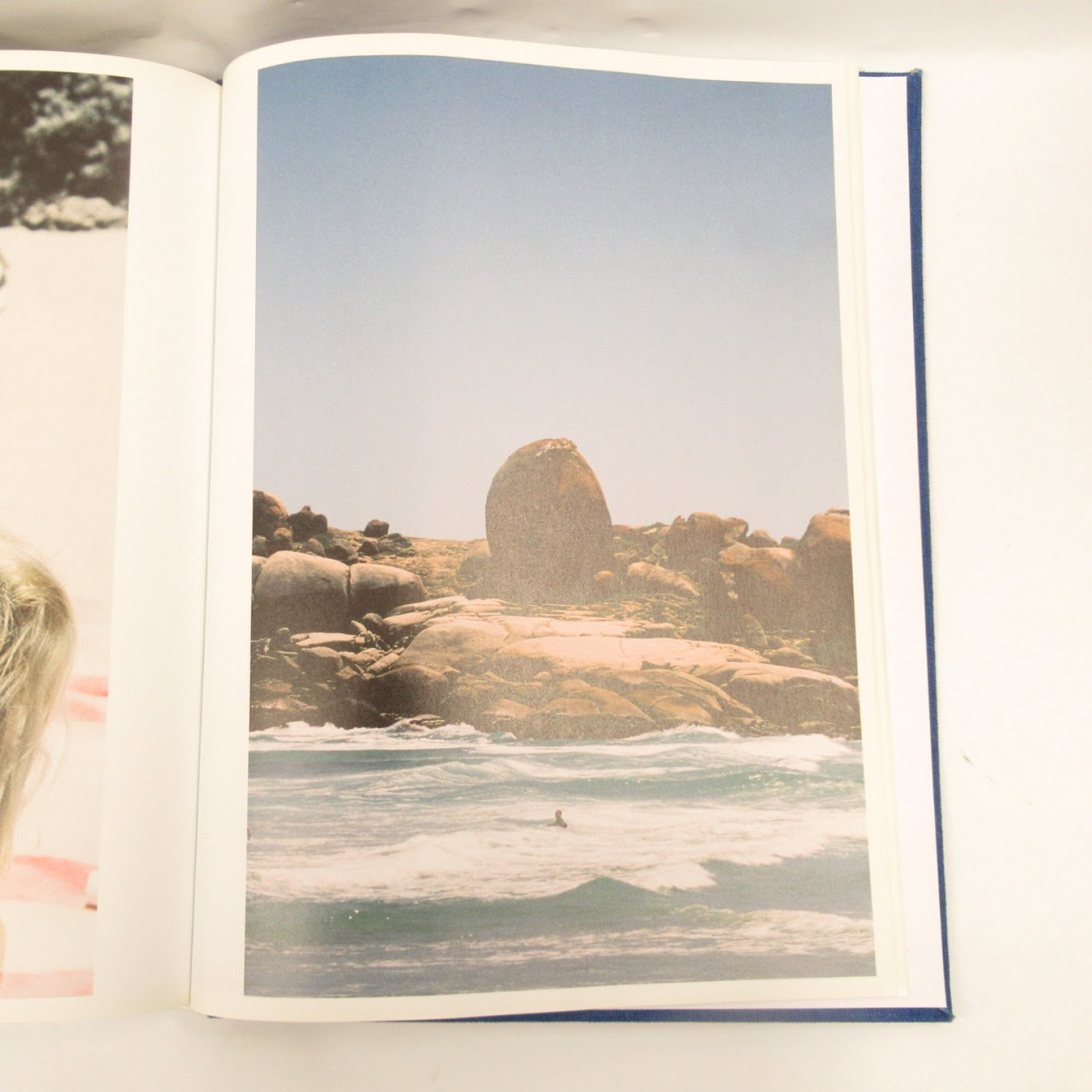
I do not care how sharp your sensor is. I do not care how many pixels your file holds. If you do not print it, you do not have it. Film ages. Paper fades really slowly. Pigment can live for centuries. There are negatives from the 1950s still printing perfectly today. Archival inkjet prints last longer than a career. They survive moves, deaths, floods. A digital file does none of that. It sits until the format breaks. Or the drive dies. Or the subscription ends. Or the password is forgotten. Digital is performance and infrastructure. Print is proof. Digital is a promise that might disappear. Ink is a statement. Once the image is printed, it exists. It cannot be updated. It cannot be revoked. It cannot be censored without fire. That is powerful.
commerce before culture
Nobody prints because of cost. Because of convenience. Because platforms are free. If you upload your memory to a free platform, you are leasing your archive to someone else. And they do not owe you anything. Your account will expire. Your files will be buried by new content. Companies delete what does not generate engagement. MySpace lost 50 million songs in one failed migration. Tumblr erased whole communities to save face. Google Photos silently compresses every image unless you pay for storage. This is not a conspiracy. This is business. And business is not built to remember. Culture always comes second to cost. That is why you cannot trust the cloud with your legacy.

augmented tomorrow
The next interface is coming. It is not hypothetical. Apple Vision Pro exists. Meta Quest exists. Mixed reality is real. No more mouse. No more browser. No more screen. Once that happens, all the old images will become background noise. Not compatible. Not portable. Just like that Buddhist guy said. The one who went into a 5-year monastery. He said when he entered, there were 4 BlackBerrys in his group. When he came out, every single person had an iPhone. That is how it happens. Quietly. Universally. Suddenly. We always act like technology is stable. Like we will always have access. But access is already narrowing. You will wake up one day and discover that your screen does not show you what it used to.
build backward from perfection
Stop chasing the next thing. Stop asking me what comes after this. Maybe the real future is not forward. Maybe it is backward. To what already worked. To ink. To paper. To physical forms that do not require code to exist. Maybe the answer is not in another app. Maybe it is in shelves full of prints that outlast us. We do not need to innovate our way out of this. We need to remember that photography once meant holding something. That the image was not complete until it left the screen. The photo was not finished until it could live without electricity. That is the new standard we must return to.

call to act
This is why I learned to print. I learned it the hard way. Through OSPHILIA magazine. Through trying. Through failing and restarting. Through figuring out colour profiles, paper weight, delivery chains. I didn’t just publish 13 stories. I protected them. I printed them. They are not sitting in a cloud or SSD. They are not trapped in a Google Drive or floating in the domain name. I know that 500 people in the world hold those images. On paper. In full resolution. No compression. No terms. That’s it. That’s the archive. That’s the final form.
And now I started Archive Editions. Because one magazine was not enough. I created a new publishing model. One that does not depend on volume or virality. It runs on memory. It’s zero-risk for the artists. No one has to guess. No one has to wait for permission. No one has to hope a platform doesn’t change its terms. I publish the book. I print the work. It’s not for resale. It’s for permanence.
Each curated. Each translated into print. Not an idea. A real object. Because I know the feed will forget. The platforms will change, definitely.
If you care about photography. If you care about memory. If you care about showing your children what you once saw. Move it now. Support the print. Fund the ink. Keep the images alive when the screen disappears.
sources:
Photos in 2025: “In 2025, around 2.1 trillion photos will be taken worldwide, … 5.3 billion daily, 61 400 each second.” – Photutorial / PetaPixel
https://photutorial.com/photos-statistics/ and https://petapixel.com/2025/06/18/the-number-of-photos-taken-in-2025-is-expected-to-exceed-two-trillion/Daily data creation: “We are producing over 400 million terabytes of data every day.” – Rivery (via Rivery Blog)
https://rivery.io/blog/big-data-statistics-how‑much‑data‑is‑there‑in‑the‑world/Apple removes Tumblr from App Store over child pornography content (November 2018) – CBS News, The Verge, ABC
https://www.cbsnews.com/news/tumblr-app-disappears-from-apple-app-store-because-of-child-porn/
https://www.theverge.com/2018/11/20/18104366/tumblr-ios-app-child-pornography-removed-from-app-store
https://www.abc.net.au/news/10580472Tumblr bans adult content December 17 2018, citing restoration of App Store listing – ABC/Reuters
https://www.abc.net.au/news/10580472Digital Markets Act identifies core gatekeepers – official sources
https://digital-markets-act.ec.europa.eu/gatekeepers_enSmartphone photography dominance: “94 percent of all photos are now taken on smartphones.” – Photutorial / PetaPixel
https://petapixel.com/2025/06/18/the-number-of-photos-taken-in-2025-is-expected-to-exceed-two-trillion/Film print longevity: pigment prints likely to last over 100 years – Wilhelm Imaging Research / Kodak
MySpace data loss: “MySpace lost over 50 million songs in one failed migration.” – public apology
Augmented Reality market forecast: “Global AR market will reach $198 billion by 2025.” – Emerline / MarketsAndMarkets / Meetanshi
https://emerline.com/blog/ar-future-for-consumers
https://www.prnewswire.com/news-releases/the-global-augmented-reality-ar-markets-projected-to-exceed-198-billion-by-2025-300990917.html
https://meetanshi.com/blog/augmented-reality-statistics/